Structural Memory and Dynamic Divergence
Timestamp: March 31, 2026 — 22:50
This experiment evaluates the role of memory in the emergence and stability of structures.
Experimental Setup
Three configurations are compared:
- A: System with past memory
- B: System without memory
- Structural memory: enhanced persistent memory
The system evolves over time, and both spatial structure and statistical behavior are analyzed.
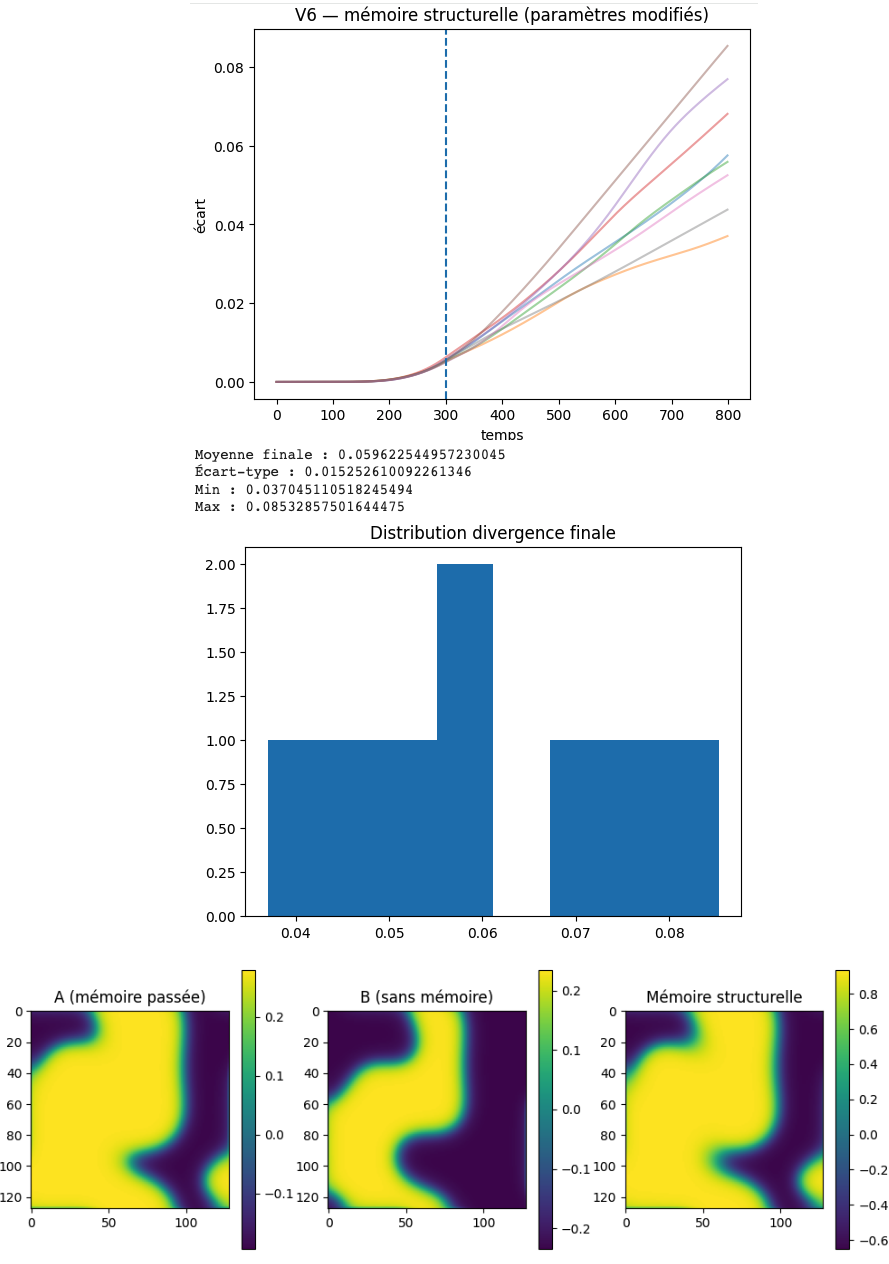
Final distribution showing non-uniform behavior
Result
Without memory, structures remain weak and unstable. With memory, coherent structures emerge and persist over time.
A clear divergence appears after a critical time threshold (t ≈ 300), indicating a bifurcation in system behavior.
Interpretation
Memory introduces temporal correlation, allowing the system to reinforce previous states instead of resetting at each step.
This leads to the emergence of stable structures and breaks symmetry over time.
The observed divergence confirms that the system transitions from a uniform regime to a structured regime after a critical point.
Conclusion
Memory is essential for the emergence and persistence of structure.
This validates that temporal correlation is a fundamental mechanism for stability and existence in the Φ-model.